Uluru Base Walk: Hiking Trails, Maps, and Climbing Ban
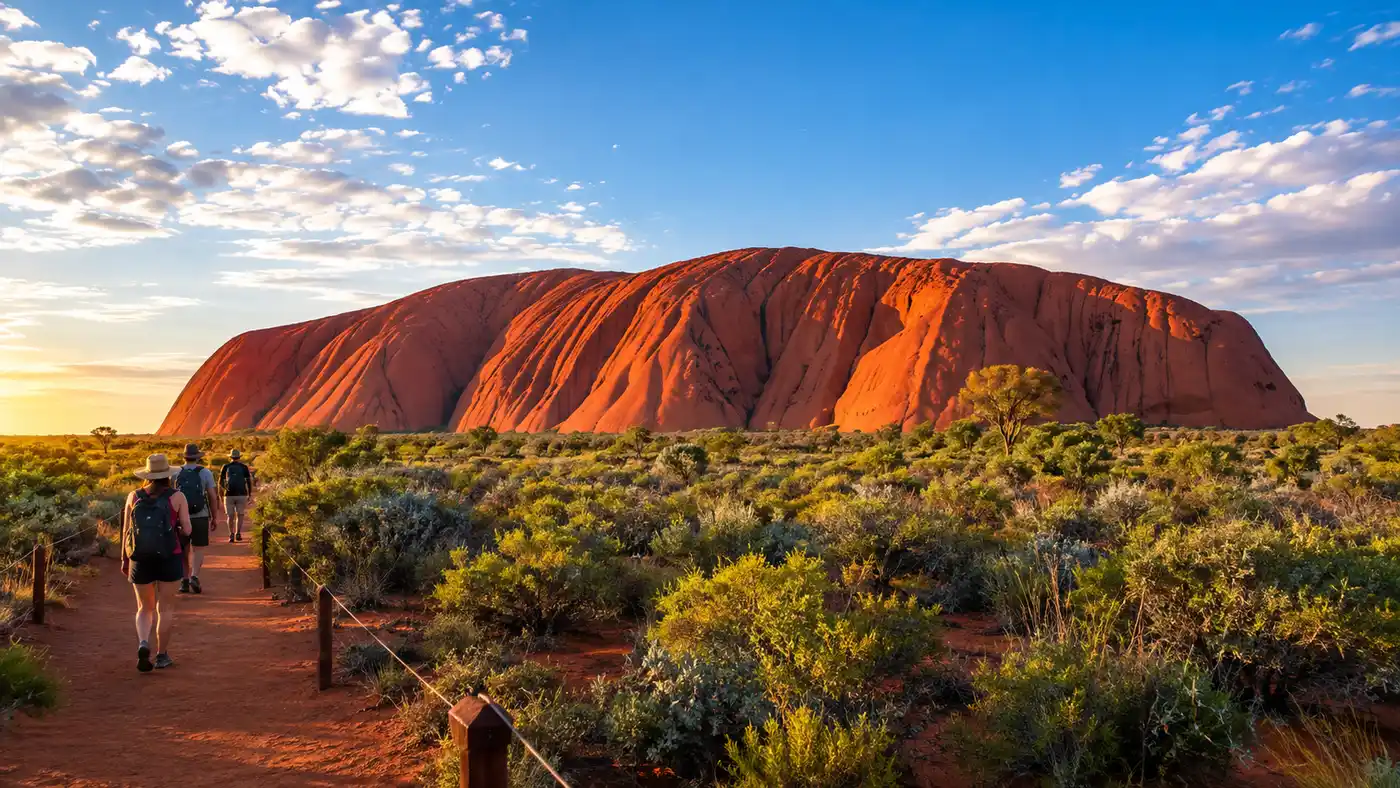
Most people arrive at the red centre expecting the monolith to look exactly like the postcards, but standing at ground level changes things completely. Up close, the sandstone isn't just a smooth red dome. It is scarred with deep vertical ribs, gouged by centuries of flash floods, and covered in pale grey lichens that cling to hollowed-out caves. Taking on the uluru base walk right at dawn gives you a front-row seat to that texture before the tour buses rumble into the car parks and shatter the quiet.
Walking around the entire perimeter gives you an honest appreciation for the scale of this place. The sheer rock faces soar 348 metres straight up into a desert sky that looks almost violently blue against the rust-coloured sand. Along the way, the route traces ancient story lines, passes through surprisingly lush desert groves, and skirts sacred sites where photography is strictly forbidden out of respect for Anangu culture. Whether you plan to tackle the full circuit or stick to shorter walking tracks, knowing how to navigate the track, the heat, and the cultural rules makes all the difference.
Book your australia uluru tour experience:
Distance, Duration, and What the Uluru Base Walk Is Actually Like
The full circuit measures 10.6 kilometres from start to finish. If you look up the circumference of Ayers Rock in guidebooks, you will find figures between 9 and 11 kilometres depending on how closely a path clings to the rock face itself. The designated trail swings out wide in several spots, both to preserve fragile ecosystems and to steer visitors away from culturally sensitive caves. It took us about 3 hours and 20 minutes to finish, though if you stop often to read the interpretive panels or sit on the shaded benches, bank on four hours.
Physically, the walk around Uluru is surprisingly easy. It is completely flat. There are no scrambles, no loose scree slopes, and no steep switchbacks. The surface switches between compacted red clay, loose sand, and occasionally a wooden boardwalk spanning dry creek beds. What makes it demanding is not the gradient; it is the sheer exposure. By 9:30 in the morning, the sun bounces off the northern rock face like heat radiating off a pizza oven. Even in shoulder months, that radiant heat drains your legs faster than you expect.
Pro tip: Start your loop from the Mala car park moving clockwise just as the sun cracks the horizon. Doing this puts the exposed, sun-drenched north-eastern stretch behind you before the desert heat hits its midday peak.
Morning light does bizarre things to the sandstone. At 6:15 am, the rock looks charcoal purple, then flashes ochre, and finally settles into a deep terracotta. Birds wake up in the mulga trees, particularly zebra finches and honeyeaters that flit between the spinifex clumps. The quiet out here is heavy. You can hear a raven flapping its wings fifty yards away, cutting through the stillness like a pair of dry bedsheets shaking in the wind.
Breaking Down the Uluru Walking Trails and Base Walk Sections
You do not have to tackle the entire 10.6-kilometre track in one go if you are short on time or travelling with young kids. The overarching circuit links several distinct shorter tracks, each with its own parking area and personality. Understanding the layout lets you patch together a morning that fits your energy levels.
| Trail Section | Distance | Average Time | Key Highlights |
|---|---|---|---|
| Full Base Walk | 10.6 km loop | 3.5 - 4 hours | Complete 360-degree view, quiet back corners |
| Mala Walk | 2 km return | 1 hour | Ancient rock art, sea-cave formations, gorge entrance |
| Kuniya Walk | 1 km return | 40 minutes | Mutitjulu Waterhole, rock art, leafy bloodwood trees |
| Lungkata Walk | 4 km return | 1.5 hours | Closest walk to the rock, dramatic undercut ledges |
| North-East Face | Varies (part of loop) | 2 hours | Vast, open savannah, views towards Kata Tjuta |
The Mala Walk is arguably the most famous spur on the mountain. It leads from the Mala car park straight into Kantju Gorge, a dramatic vertical split where rainwater crashes down after heavy storms. The walls here are stained black with organic run-off and minerals. Along the base of these cliffs, you will walk past shelters used for tens of thousands of years by Anangu ancestors, complete with visible rock art depicting tracks and ceremonies.
Over on the southern flank sits the Kuniya Walk, an easy stroll ending at the Mutitjulu Waterhole. This is one of the few semi-permanent water sources around the base. It feels completely different from the dry spinifex plains just a few hundred yards away. River red gums push up between red boulders, and the air stays cool even when the gravel outside is hot to the touch. The rock face above the pool displays huge wavy ridges that Anangu associate with the epic battle between Kuniya, the woma python woman, and Liru, the poisonous brown snake.
- Look for ancient grindstones: near several of the caves on the Mala track, you can see smooth indentations in the rock floor where seeds were ground into paste for generations.
- Watch for fresh animal tracks: early walkers will spot fresh dingo prints, monitor lizard tail-drags, and tiny marsupial hopping tracks pressed clean into the overnight sand.
- Keep an eye out for desert frogs: after rare desert rainstorms, the depressions near Mutitjulu fill up and spadefoot toads emerge from underground burrows in the hundreds.
- Notice the sheer undercut curves: along the Lungkata stretch, massive curved wave shapes overhang the trail where centuries of wind and water have eaten away the softer layers.
The Uluru Climbing Ban: Why You Can't Climb Ayers Rock
For decades, tourists treated the climb to the top of Uluru as a desert rite of passage. A metal chain was bolted into the western ridge back in the 1960s, guiding visitors up a sheer 800-metre slant. That era is over. On October 26, 2019, the climbing ban permanently closed the chain trail. Today, walking around Ayers Rock is the primary way people experience the formation, and the old metal chain has been pulled out to let the rock heal.
Understanding why you can't climb Uluru comes down to cultural authority and safety. To the Anangu, the rock is not a theme park or a peak to conquer. It is a living landscape infused with Tjukurpa, the ancestral law and stories that govern their world. The route tourists climbed crossed directly over the path walked by the ancestral Mala men arriving for ceremony. For decades, Anangu stood at the base handing out flyers asking visitors not to climb, choosing education over anger. It took decades of negotiation before the national park board voted unanimously to close the route for good.
Note: Certain sections around the base are sacred sites where photography and filming are prohibited. Clear signs indicate where cameras, phones, and drones must be packed away, protecting sacred women's and men's ceremonial knowledge from public display.
There was a harsh practical side to the closure as well. The climb was brutal. Over 35 people died climbing Uluru over the years, mostly from massive heart attacks triggered by intense exertion in punishing heat, or from fatal falls off slippery, windswept domes near the summit. Dehydration, vertigo, and sudden wind gusts made rescue operations dangerous for park rangers. If you want a deeper look at the cultural history and geology, take a look at our guide to Uluru facts, history, and Aboriginal significance before you arrive.
Book your australia uluru tour experience:
Costs, Permits, and Planning Your Uluru Hike
A lot of folks wonder how much does it cost to walk around Uluru once you are there. The track itself does not require a separate hiking fee, but every visitor needs a valid park pass to enter Uluṟu-Kata Tjuṯa National Park. A standard adult pass costs $38 and stays valid for three consecutive days. Children aged 17 and under get in free. You buy these online before you drive through the entry gate, and rangers scan the QR code from your phone or printed slip.
Carrying the right gear is what separates a pleasant desert hike from an exhausting ordeal. Even at dawn, the arid climate pulls moisture out of you surprisingly fast. If you visit between October and April, afternoon temperatures frequently push past 41 degrees Celsius. In fact, if the forecast reaches 38 degrees or higher, rangers close the full 10.6-kilometre walk early in the day for safety reasons, leaving only the shorter shaded sections open. Planning the timing of your trip makes all the difference, so check our advice on the best time to visit Uluru to dodge the brutal summer sweeps.
- Carry at least one litre per hour: park authorities recommend three litres per person for the full base loop; do not rely solely on water stations because desert plumbing can occasionally fail.
- Pack a fine fly net: from September through March, native bush flies are relentless, swarming faces for moisture; a $10 mesh net worn over a broad-brimmed hat will keep you sane.
- Wear low-cut trail runners: stiff mountaineering boots are overkill for this flat surface; comfortable runners or lightweight trail shoes that shed sand easily are much better.
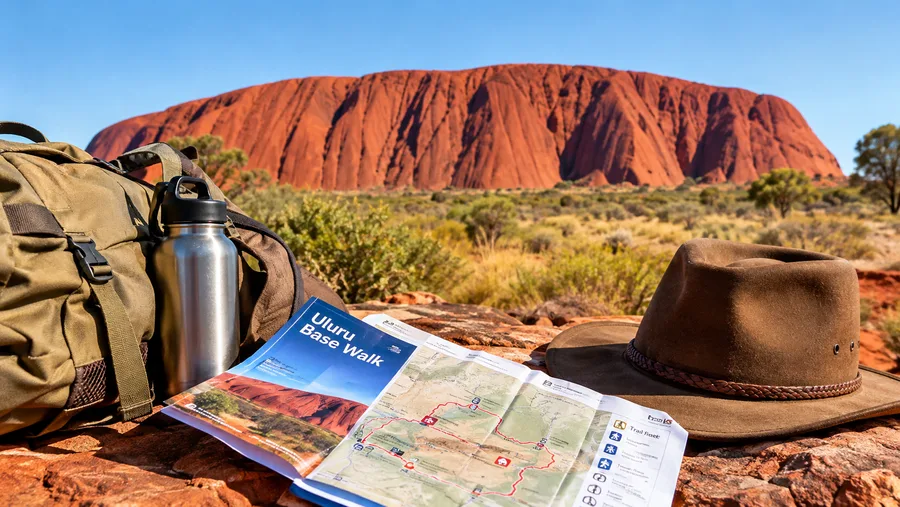
- Pick up a map at the cultural centre: the park brochure features an excellent topographic outline showing all toilets, emergency call points, and shade shelters dotted along the path.
Guided Walking Tours vs Tackling the Loop Alone
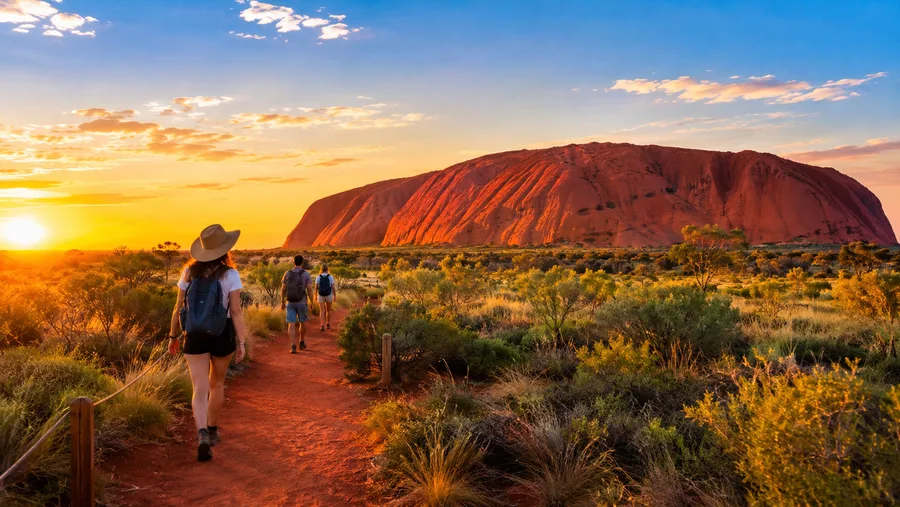
Walking the loop independently is easy. The track is broad, well-signed, and impossible to lose. You can pop in headphones, walk at your own rhythm, and lose yourself in the scale of the landscape. Benches are positioned every few kilometres under wooden shelters, giving you places to catch your breath and shake sand out of your shoes. If you are reasonably fit, walking alone lets you finish before the desert gets hot.
Joining an organized walking tour offers something you can't get from guideboards alone. Local guides point out subtle details you would walk straight past, like bush medicine plants, sweet honey grevillea nectar, and the camouflage nests of trapdoor spiders in the hard red clay. Every morning, rangers lead the free Mala Walk starting from the Mala car park around 8:00 am (check seasonal boards, as this shifts earlier to 7:45 am in summer). It covers about two kilometres return and lasts 90 minutes. Listening to an Indigenous guide speak about their ancestral connection while you stare at ancient cave walls gives you goosebumps that solitary walking rarely matches.
If walking isn't appealing, you can hire a bicycle near the cultural centre or join a segway tour that rolls around the rocky skirts. Honestly, I think walking remains the best way. Moving on foot keeps your pace slow enough to notice tiny details, like the sudden scent of desert mint after morning dew or the texture of weathered arkose sandstone beneath your palm.
Frequently Asked Questions about uluru base walk
How long does it take to walk around Uluru?
The 10.6-kilometre loop takes most walkers between 3 and 4 hours. It is completely flat with no climbing, but the heat and soft sand can slow you down if you do not start early.
Can you climb Uluru still?
No. Climbing Uluru was permanently banned on October 26, 2019 out of respect for Anangu traditional owners and for visitor safety. The old climbing chain has been removed.
Are there toilets along the Uluru base walk track?
There are modern toilet facilities at the Mala and Kuniya car parks, as well as a composting toilet shelter along the base track on the northeastern side. Carry your own hand sanitiser.
Can you do the base walk in the afternoon?
You can, but it is rarely recommended during warmer months. In summer, the base loop is closed by 11:00 am whenever temperatures exceed 38 degrees. Early morning provides cooler weather and sunrise colours.
Quick Reference
- 10.6 km flat circuit track
- 3 to 4 hours walking time
- $38 adult park entry pass
- Permanently closed to climbing since 2019
- Carry minimum 3 litres of water
Book your australia uluru tour experience:
The Bottom Line
Skipping the base walk leaves you with only half the story of this desert icon. Watching the rock shift from deep mauve to roaring red from an air-conditioned bus is fine, but feeling the sand under your boots and hearing the desert birds wake up in Kantju Gorge is what sticks in your memory years later. Pack your fly net, fill your water bottles to the brim before you leave your hotel, and step out onto the red dirt trail just as the morning light breaks.
Read more about australia uluru tour.